 EN
 NL
Why context became the question

- Written by
- Vincent Pieterse
- Published on
- 21 October 2026
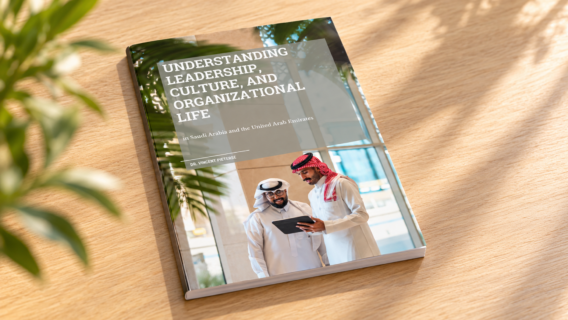
My book, Understanding Leadership, Culture, and Organizational Life in Saudi Arabia and the United Arab Emirates, grew out of years of research, teaching and working with leaders. The curiosity behind it began much earlier.
Download the full book — free PDF.
My father worked for the European Space Agency, and families from Europe, Asia, the United States and Australia were part of the ordinary social world around us. Differences appeared in conversation, humor and hospitality, and in the small misunderstandings through which people discover that what feels self-evident to one person may not feel self-evident to another.
Those experiences left me with an intuition that has stayed with me: people carry worlds with them. Family, education, language and relationships enter what feels respectful, responsible or possible. Yet the person in front of us always has more to reveal than those influences alone can explain.
I continued to encounter this relationship between the person and their world through organizational leadership, teaching, academic research and executive coaching.
Again and again, there was a distance between a visible action and the meaning assigned to it. A decision that appeared hesitant from one position could be experienced as responsible consultation from another. Silence could mean agreement, uncertainty or a judgment that the consequential conversation belonged elsewhere.
The behavior was visible. Its meaning was not.
Sometimes the misunderstanding was my own. More than twenty years ago, while directing a leadership program for a Dutch bank, I participated in a meeting at a bank abroad. We followed the English conversation but failed to recognize that a decision had been made to let 70 employees go. We only understood this afterwards, when our host, the CFO, spoke about it on the walk back to our hotel.
That encounter stayed with me because it exposed the expectations I had brought into the room. I had assumed I would recognize a decision when I heard one.
My academic work gave me ways to examine how language, identity and relationships shape organizational life. My professional work kept those questions close to people who had to act. Leaders inherit roles others already recognize, relationships that carry obligations, and institutions whose histories remain present. They still have to decide.
Over the past eight years, coaching Middle Eastern executives through IMD Business School made these questions more demanding. My work with leaders and organizations in Saudi Arabia and the United Arab Emirates through John Mattone Global gave the inquiry further practical grounding and the momentum to write.
Much of the management language was familiar. Understanding what accountability, empowerment or purpose meant in a particular situation required closer attention. An approach that appeared transferable could depend on forms of authority or trust that had not traveled with its name.
Saudi Arabia and the UAE also resisted being treated as one setting. Their distinct histories and institutions mattered. Within each country, the organization and the person continued to change what I thought I understood.
I began returning to these encounters through writing, bringing experience into conversation with scholarship from the region and beyond. The question running through that work was:
How does leadership become understandable within a particular cultural, organizational, and social context?
The book brings together fourteen evidence-informed essays that keep a particular leader in view. They explore how authority becomes usable, how disagreement acquires consequence, and how people lead within institutions that are themselves changing. They also examine the assumptions through which an observer decides what those actions mean.
In bringing different bodies of scholarship together, I wanted each to remain capable of questioning the other. A familiar framework can help us notice something important. The encounter may also reveal what that framework has overlooked.
The book is written for experienced people who work seriously with leadership. It assumes familiarity with organizational life and asks readers to stay with ambiguity long enough for familiar explanations to become less automatic.
That invitation carries a responsibility. A fuller understanding of context does not make harmful conduct acceptable or remove the leader’s agency. It should help us judge more carefully, with greater attention to the people who experience the consequences.
My hope is that the essays offer readers a thoughtful companion in situations where they recognize the language of leadership but still find themselves wondering what is happening.

Latest Insights







A place to think aloud
An article can open a question. Coaching creates a confidential space to explore what that question means in the context of your own role, organization, and situation.
If an insight here connects with something you are facing, you are welcome to start a conversation.